What is SHA-256 and when should you use it?
A practical guide to SHA-256: what it does, how it differs from encryption, where it is useful, and when you should choose a password hashing algorithm instead.
SHA-256 in one sentence
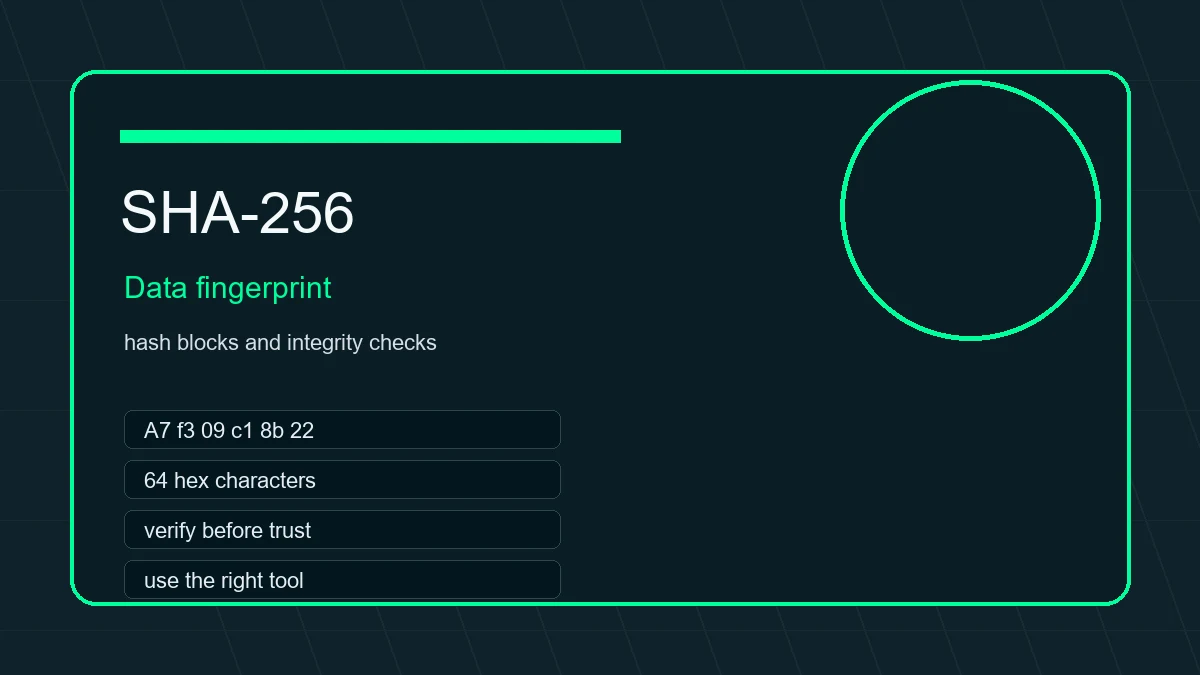
SHA-256 is a cryptographic hash function that turns data of any size into a fixed 256-bit fingerprint, usually shown as 64 hexadecimal characters.
That fingerprint is useful because even a tiny change in the original input creates a very different hash. If one character in a file, message, or configuration changes, the SHA-256 result changes too.
Hashing is not encryption
People often mix up hashing, encryption, and encoding. They solve different problems:
| Method | Reversible? | Main purpose |
|---|---|---|
| Hashing | No | Fingerprints, integrity checks, tamper detection |
| Encryption | Yes, with a key | Confidentiality and secrecy |
| Encoding | Yes, no secret key | Formatting data for transport or display |
SHA-256 is not something you decrypt. You compare hashes. If the expected hash and the calculated hash match, the data is probably unchanged.
Where SHA-256 is useful
SHA-256 is commonly used for:
- Checking downloaded files against a published checksum.
- Detecting changes in backups, logs, or configuration files.
- Creating fingerprints for API payloads and data records.
- Supporting digital signatures and certificate workflows.
- Verifying that two pieces of data are identical without sharing the full data.
For example, a software vendor may publish a SHA-256 checksum beside a download. After downloading the file, you calculate its SHA-256 hash locally. If both values match, the file likely arrived intact.
When SHA-256 is not enough
Do not use plain SHA-256 for password storage. Passwords need a slow, salted password hashing algorithm such as bcrypt, Argon2, or scrypt. SHA-256 is fast, and speed helps attackers test many password guesses quickly.
You should also avoid SHA-256 when you need secrecy. If data must be recovered later, use encryption instead.
How to test SHA-256 on Cyberonz
Use the free SHA-256 generator to enter sample text and see the resulting hash. For learning, try hashing:
helloHellohello.
The results will be completely different, which is the point of a cryptographic fingerprint.
Best practices
- Compare hashes from trusted sources only.
- Treat hashes of sensitive data as sensitive.
- Use lowercase or uppercase consistently when comparing hex strings.
- Use password hashing algorithms for passwords, not SHA-256 alone.
- Document which algorithm produced a checksum so users do not guess.
FAQ
Is SHA-256 reversible?
No. SHA-256 is one-way. You cannot decrypt a SHA-256 hash back into the original data.
Can two files have the same SHA-256 hash?
In theory, collisions are possible for any fixed-size hash. In practice, finding a useful SHA-256 collision is not feasible with current public computing capability.
Is SHA-256 still safe?
For integrity checks and many fingerprinting use cases, yes. For password storage, use bcrypt, Argon2, or scrypt instead.