What is hashing in cyber security?
A beginner-friendly guide to cryptographic hashing, integrity checks, password storage, digital fingerprints, and common mistakes to avoid.
Hashing in plain language
Hashing turns data into a fixed-size fingerprint. The same input should produce the same hash, but a small change in the input should produce a very different result.
Cyber security teams use hashes to verify integrity, compare data safely, detect tampering, and support password storage systems.
What makes a cryptographic hash useful?
A good cryptographic hash function has three important properties:
- It is one-way: you cannot realistically reverse the hash into the original input.
- It is sensitive to change: tiny input changes create very different outputs.
- It is collision resistant: finding two useful inputs with the same hash should be infeasible.
Common uses of hashing
Hashing appears in many security workflows:
- File checksums for downloads and backups.
- Tamper detection for logs and configuration files.
- Digital signatures and certificates.
- Password storage when combined with salt and a slow password hashing algorithm.
- Malware and forensic file identification.
Hashing vs password hashing
This distinction matters. SHA-256 is useful for integrity checks, but it is not ideal for storing user passwords by itself.
Password storage should use algorithms designed to slow attackers down:
- bcrypt
- Argon2
- scrypt
These algorithms add salt and cost parameters, making large-scale guessing harder.
Example: why one character matters
The text hello and Hello look almost the same to a person. To a hash function, they are completely different inputs and produce completely different hashes.
Try this with the SHA-256 generator and compare the results.
Mistakes to avoid
- Do not call hashing encryption.
- Do not use fast hashes alone for password storage.
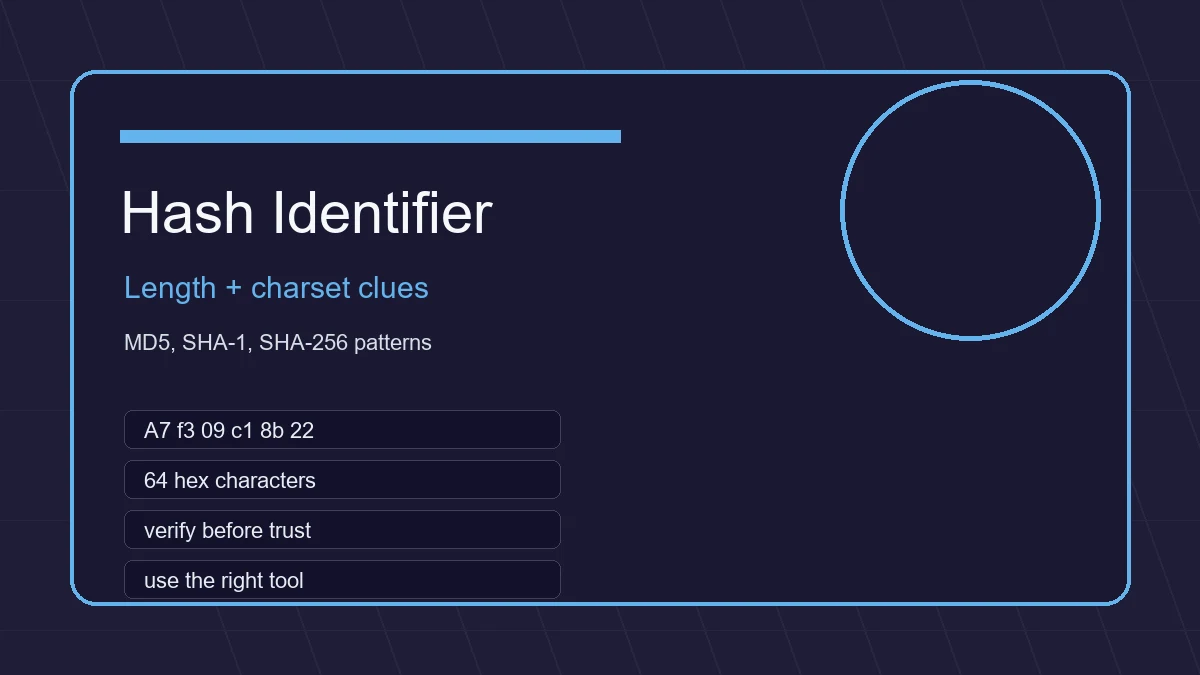
- Do not assume a hash identifier can recover the original input.
- Do not publish sensitive hashes unless you understand the risk.
- Do not compare hashes from untrusted sources without context.
Useful Cyberonz tools
FAQ
Can hashes be cracked?
Hashes are not decrypted, but weak original inputs can sometimes be guessed. Attackers hash many guesses and compare the results.
Is hashing useful outside passwords?
Yes. Hashing is widely used for file integrity, tamper detection, digital signatures, and data comparison.